
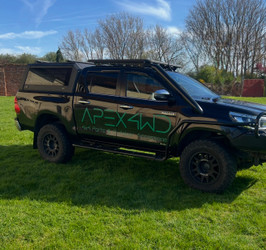
Do You Need an Aluminium Flat Roof Rack?
Posted by Apex4WD Team on 17th Aug 2026
There's a point in every build where the boot's full, the drawers are packed and you're still stood in the driveway holding an awning, a set of recovery boards and a bag of firewood with nowhere to put them.
That's usually when people look up.
The roof is the one part of the vehicle most owners never use and a flat roof rack is the simplest way to turn it into load space. The real question isn't whether a rack helps, it's what it's made of, because aluminium and steel pull in very different directions.
Put simply: steel is cheaper and takes a beating, aluminium is lighter and sits in a far better place on the vehicle. For most road-driven 4x4s and pickups, that weight difference matters more than people expect.
What a Flat Roof Rack Actually Does
A flat rack, sometimes called a platform rack, is a low, open platform that mounts across the roof and gives you a single flat surface to load, strap and bolt things to. No high sides, no basket, just a clean deck with tie-down points and mounting channels.
Why fit one?
- It frees up the inside of the vehicle for the gear you actually want to reach
- Bulky, light kit lives up top and out of the way - chairs, awnings, roof tents, fuel cans
- The flat deck takes a rooftop tent, an awning or a roof bag without a fight
- Low profile means you keep more height for car parks, barriers and the garage
- Plenty of mounting points, so accessories bolt straight on instead of being bungeed down
A flat deck is the most versatile shape you can fit. You're not locked into one use, it's a base you build on.
2. Why Aluminium Over Steel
Steel racks have been the default for years, and there's nothing wrong with them, cheap, strong and hard to kill. But every kilo you add to the roof sits in the worst possible place on the vehicle.
Weight up high raises your centre of gravity, which you feel in the corners, on side slopes and in a sudden swerve. It also eats straight into your roof load rating, every kilo the rack weighs is a kilo of gear you can't carry.
Aluminium is where a flat rack earns its keep:
- Significantly lighter than the steel equivalent, so more of your roof rating goes to actual kit
- Less weight up high, so the vehicle drives closer to how it did standard
- Won't rust, aluminium shrugs off the salt, rain and winter roads that quietly eat steel
- Low-profile black finish that doesn't spoil the lines of the vehicle
- T-slot channels along the frame let you slide and bolt accessories anywhere, not just at fixed holes
The trade-off is honest: aluminium usually costs a bit more up front and a good steel rack will still carry plenty, but on a vehicle that spends most of its life on the road, the weight saving is the thing you notice every day.
Our aluminium flat rack range covers most of the common pickups and 4x4s. There are slim, factory-fit racks that bolt to your vehicle's own mounting points for the Toyota Hilux, Isuzu D-Max, Nissan Navara, Mitsubishi L200 and VW Amarok, plus universal low-profile cages in 135x125cm and 220x125cm for larger roofs and custom-fit options for the Land Cruiser 100 and Land Rover Discovery (3 and 4).
3. What You'll Actually Bolt To It
This is where a flat rack comes into its own, because the deck is flat and covered in mounting points, it takes almost anything:
- An awning down one or both sides for shade and rain cover at camp, it bolts on with the awning mounting bracket kit.
- A rooftop tent, for one of the fastest setups on the site
- Recovery boards, jerry cans and a shovel, traction boards strap down with the ratchet strap kit and fuel or water sits in the 20L jerry can holder.
- A waterproof roof bag for bulky, light gear like bedding and clothes
- Auxiliary lighting up front, spots or a light bar on the light mount kit.
Everything locks down properly with the eye-bolt tie-down set and a platform roller kit makes loading heavy or awkward gear far less of a wrestle. The point of the flat deck is that it doesn't dictate how you use it. Start with a roof bag, add an awning later, fit a tent when you're ready. It grows with the build.
4. Dynamic vs Static Load - The Bit Nobody Explains
Roof racks have two load numbers and mixing them up is how people get caught out.
Dynamic load is what the rack and your roof can carry while you're driving. It's the lower of the two and it's the one that matters for cargo, boards, bags, a tent while you're on the move.
Static load is what it holds parked up, with nothing moving. It's much higher, which is why a rooftop tent can safely sleep two adults once you've stopped, even though people plus tent would blow past the dynamic figure.
Two things worth remembering. Your vehicle's own roof rating is usually the real limit, not the rack's, check the handbook and the dynamic figure is the one to respect on the road, especially loaded and cornering.
Worth Knowing Before You Buy
No rack is free of downsides, so here's the honest list:
- Anything on the roof changes how the vehicle handles, most noticeably when it's loaded
- A rack adds a little wind noise and costs you some fuel, even empty
- You're adding height, so measure against your garage, your car park and any barriers you use regularly
- Loading the roof is a lift, heavy items still belong low and forward, not up top
- Payload maths still applies: the rack's weight, plus everything on it, comes out of your plated limit
None of these are reasons not to fit one. They're just the things worth knowing before you do.
Before You Buy
Five quick checks:
- Pick your mounting method, a slim factory-fit rack bolts to your vehicle's own points, while a universal cage mounts on gutter brackets (we stock standard and high-roof sizes for taller vehicles like the Defender and Discovery)
- Check your vehicle's roof load rating in the handbook, then work to that, not just the rack's number
- Be honest about height, if you use a low garage or car park daily, a flat low-profile rack is the one to have
- Plan what's going on it, so you buy the right mounts first time rather than twice
- Keep the heavy stuff inside and low; save the roof for bulky and light
Final Thoughts
A roof rack won't be the most exciting thing you bolt to your 4x4, but it's one of the most useful, it changes how much you can carry and how fast you can set up camp. Go aluminium and you get the space without loading the worst part of the vehicle with dead weight.
You can see the full aluminium flat rack range here and if you want a hand working out what fits your vehicle, give us a call on 01462 516137 or email sales@apex4wd.co.uk. Collection is available from our unit at SG5 4NZ.
Still deciding where a rack fits in your build? Our guide to 4x4 storage systems covers drawers, boxes and canopies, and it's worth a read alongside our roof tent and overland camping guide if a tent's on the list.