
The Best Scenic Spots in the UK for 4x4 Owners and Overlanders
Posted by Apex4WD Team on 10th Aug 2026
You do not need to ship your truck to Morocco to get something out of it. Some of the best driving and camping in Europe is within a day's drive of most of the UK, and a well set up 4x4 makes those places far easier to reach and far more comfortable to stay in.
Here are five regions we keep coming back to, what makes each one worth the fuel and the kit that earns its place in the back.
1. Snowdonia and Mid Wales
Wales punches well above its weight. Eryri (Snowdonia) gets the attention, but the quieter roads further south are often the better drive.
Worth pointing the bonnet at:
- Bwlch y Groes - one of the highest paved roads in Wales, steep, narrow and genuinely spectacular
- The Elan Valley - reservoirs, dams and empty moorland roads with almost no traffic midweek
- Llanberis Pass - the classic Snowdonia run, best done early before the car parks fill
- The Black Mountains and Gospel Pass - the highest road in Wales, and a brilliant approach to the Brecon Beacons
Mid Wales also has one of the densest networks of legal unsurfaced byways in the country, which is why it is such a popular base for green laning weekends. More on doing that properly further down.
Best time to go: late spring and early autumn. Summer weekends around Snowdon are busy.
2. The Peak District
The Peaks are the most accessible of the lot for anyone in the Midlands or the North, and you can get a proper day out without a long drive to reach the good bit.
Worth pointing the bonnet at:
- Winnats Pass - a limestone gorge road near Castleton that never stops being impressive
- Snake Pass - moorland crossing between Glossop and the Ladybower reservoir
- The Ladybower and Derwent reservoirs - easy access, good walking, and a decent base for a weekend
- Curbar Edge and Stanage Edge - gritstone edges with big views over the Hope Valley
The Peak District is also within striking distance for a Friday night departure, which makes it ideal if you have a roof tent already fitted and want to make the most of a short weekend.
Best time to go: autumn. The heather and bracken colour is worth planning around.
3. The Lake District
If you want the two best tarmac passes in England back to back, this is where you go.
Worth pointing the bonnet at:
- Hardknott Pass - gradients up to 1 in 3, hairpins, and a Roman fort at the top. Not one for a nervous passenger
- Wrynose Pass - runs straight into Hardknott, so most people do both in one go
- Honister Pass - Borrowdale to Buttermere, slate quarries and steep walls either side
- Kirkstone Pass - the highest pass in the Lakes that is open to traffic year round
A word of caution: Hardknott and Wrynose are single track with passing places, and they get blocked by nervous drivers and unsuitable vehicles regularly. Go early, go slow, and be ready to reverse.
Best time to go: midweek, any season except deep winter. Both passes close in ice and snow.
4. The Scottish Highlands
The Highlands are the closest thing the UK has to genuine expedition country. Distances are real, phone signal is patchy, and the scenery does not let up for days.
Worth pointing the bonnet at:
- Bealach na Ba - the Applecross pass, and arguably the best road in Britain. Single track, huge gradients, and a view over Skye from the top
- The NC500 - the north coast loop from Inverness. Popular now, but split it over a week and take the detours and it is still superb
- Glen Coe - short, dramatic, and busy for good reason
- The Cairngorms - Glenshee, the Lecht and the roads around Braemar, plus the biggest tract of high ground in the UK
- Ardnamurchan and Argyll - the quieter west coast, ferries, single track roads and the most westerly point on the mainland
Scotland is also the only part of the UK with a broad statutory right of responsible access, which under the Land Reform (Scotland) Act 2003 covers wild camping on foot. It does not cover driving off road or parking overnight wherever you like, so use designated spots and stopping places.
Best time to go: May and September. May gets you long days before the midges arrive properly, September gets you colour and quieter roads.
5. Devon, Dartmoor and Exmoor
The south west is underrated by anyone who has only driven the A30 through it.
Worth pointing the bonnet at:
- Dartmoor - open moorland, tors, and some of the most atmospheric camping in England
- Exmoor - Porlock Hill, the Doone Valley, and a Dark Sky Reserve for anyone who wants stars
- The North Devon coast road - Lynton, Lynmouth and the cliffs above them
- The Quantocks - quieter than Exmoor next door and a good overflow option in August
Dartmoor is worth a special mention. In May 2025 the Supreme Court confirmed the public right to wild camp on the Dartmoor Commons, making it the only place in England and Wales where that right is written into law. It applies to backpack style camping within the National Park's code of conduct, not to parking a vehicle up on the moor, so plan to walk in from a legitimate parking spot.
Best time to go: September and October, once the school holiday traffic has cleared.
Green Laning: Do It Properly
This one matters, because the access we have is easy to lose.
In England and Wales you can legally drive unsurfaced roads that carry vehicular rights, mainly Byways Open to All Traffic and some unclassified county roads. You cannot drive on bridleways, footpaths or open moorland, and a lot of routes carry seasonal Traffic Regulation Orders that close them in winter or permanently.
Before you go:
- Check route status with GLASS (the Green Lane Association) or the Trail Riders Fellowship rather than relying on a map app
- Check the local authority for current Traffic Regulation Orders
- Travel in small groups, two or three vehicles is plenty
- Stay on the defined route, do not widen it to avoid ruts
- Turn back if conditions mean you would cause serious damage
- Take everything out with you, including other people's rubbish if you can
Scotland has no equivalent green lane network, and the right of responsible access does not extend to motor vehicles. Stick to public roads and estate tracks you have permission to use.
What to Pack
Some of this is obvious, some of it only becomes obvious once you have gone without it.
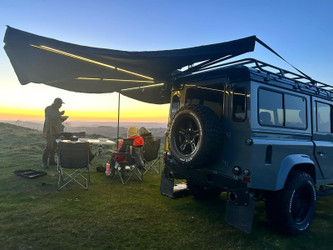
- Somewhere to sleep. A roof top tent gets you off wet ground and set up in minutes, and an awning gives you somewhere dry to stand when Welsh weather does what Welsh weather does.
- Somewhere to put things. A proper storage system stops your boot turning into a jumble of loose kit. We have written a full guide to choosing between boxes and drawers if you are weighing it up.
- Recovery kit. Even on tarmac passes, a soft verge and a wet weekend will catch you out. A basic recovery kit and ideally a winch if you are travelling remote.
- A fridge. A 12V fridge changes how you eat on a long trip, and removes the daily ice run.
- Roof capacity. A roof rack or a canopy frees up the cabin and gives you somewhere to mount tents, awnings and lighting.
- Ground clearance. A modest lift kit makes rutted lanes considerably less stressful.
- Paper maps. Highland phone signal is not to be relied on.
If you are still early in your build, our guide to the best 4x4 upgrades to buy first covers the order we would tackle things in.
Final Thoughts
The best trips are rarely the furthest ones. A Friday night run to the Peaks with a tent on the roof will give you more than a fortnight of planning a trip you never quite book.
Pick a region, get the vehicle sorted, and go. And whatever you do, leave the place better than you found it, because the access we all rely on depends on it.
At Apex4WD we stock everything from roof tents and awnings to storage systems, recovery gear and canopies for pickups and 4x4s. If you are planning a trip and not sure what you are missing, give us a call on 01462 516137 or email sales@apex4wd.co.uk and we will talk it through.